Header Image

HGT Online Lecture: The Role of Gen Z in the October 6 Commemoration between 2018—2025

Date: Friday, 27 February 2026

14.00 – 16.00 hrs. (CET) or 20.00-22.00 (Thai time)

From 2020 to 2021, Thailand witnessed a youth-led political uprising that reshaped public engagement with democracy and revived interest in long-suppressed historical narratives. Central to this shift is Gen Z’s growing political awareness, grounded in Thailand’s past, including long-silenced events such as the 6 October 1976 massacre. This lecture examines how young Thais today interpret this event and employ commemorative practices as countermemory to challenge state narratives and articulate democratic aspirations.

The study focuses on commemorations at Thammasat University from 2018 to 2025, spanning the period before and after the 2020 uprising. Drawing on interviews with organizers and participants, alongside an analysis of online discourse, it explores how the memory of 6 October is mobilized and understood. Observations show that these commemorations have become larger, more participatory, and more explicitly political since 2020. A once modest memorial has developed into a broader remembrance of state violence, linking 1976 to incidents such as Tak Bai in 2004 and recent repression. The analysis demonstrates how youth transform remembrance into political action, challenging official silence and envisioning a more democratic future.

About the lecturer:

Bancharat Polpila completed her Master’s degree at Leuphana University in Lüneburg in early 2025. She is currently a PhD candidate and a lecturer at the University of Passau and a research associate at the Chair of Development Politics. Her research focuses on social movements, democratization, and authoritarianism.


Online Lecture via Zoom & in English

https://uni-hamburg.zoom.us/j/64563521222?pwd=OEdSbENCOUV2Ynl5ZUdnNG5mM1pwQT09

Meeting-ID: 645 6352 1222  ||  Passcode: hgtlecture


Online Lecture: Dr. Friedrich Schäfer and the Creation of a Public Health Service in Early Twentieth-Century Siam

Dr. Friedrich Schäfer and the Creation of a Public Health Service in Early Twentieth-Century Siam

This study examines the role of German medical experts during the reigns of Rama V (1868-1910) and Rama VI (1910-1925), with a particular focus on the German surgeon, Dr. med. Friedrich Schäfer, who served in the Siamese army between 1909 and 1914. By exploring western influence on the Siamese administration between 1868 and 1911, this study analyses Schäfer’s role in the Siamese military and as a consultant for the construction of King

Chulalongkorn Memorial Hospital and the development of the country’s medical education.

Dr. Schäfer helped lay the foundation for modern surgery in Thailand. He made significant contributions to the advancement of medical and surgical training and assisted in the construction of advanced military hospitals in Bangkok and surrounding areas. As a sharp observer, he documented natural phenomena in Bangkok and other cities, as well as the rapid urban expansion at the end of King Chulalongkorn’s reign.

About the lecturer
Kornkanok Khetnongbua is a PhD Candidate in Southeast Asian History at the Faculty of Humanities, University of Hamburg. She is a recipient of the State Graduate Funding Program scholarship (Hamburger Nachwuchsförderung, Stipendien der Landesgraduiertenförderung HmbNFG), which supports her dissertation on the geopolitical dynamics of the region. Her project specifically examines German – English Rivalry in Semi-colonial Siam (1862-1917). Further contributing to the field, her Master’s thesis has been accepted for an upcoming volume in the HGT series.

Friday, 6 February 2026 14:00—16:00 (CET)
20:00-22:00 (Thai time)

Click or Copy:
https://uni-hamburg.zoom.us/j/64563521222?
pwd=OEdSbENCOUV2Yn|5ZUdnNG5mM1pwQT09
Meeting-ID: 645 6352 1222 || Passcode: hgtlecture


Online Lecture: Craft Schools and Culture in the Bourgeois Context of Phetchaburi, Central Thailand from 1907 to 1957 (17 Jan 2025)

Phetchaburi is historically recognized as the city for handycraft schools since the Late Ayutthaya Period. In the first half of the twentieth century, temple craftsmanship evolved due to changes in local temple culture, which served to transmit skills from Central Thailand. As Bangkok art and cultural trends spread, Phetchaburi became an economic hub because of expanded rice cultivation and trade. The bourgeoisie emerged as art consumers who patronized craftspeople and backed the formation of student apprenticeship groups led by Buddhist monks and laypersons at major urban temples. Buddhist monks first became involved in crafts in Phetchaburi around 1907, with Rit, the abbot of Wat Plapphlachai, leading. Five temple crafts groups provided sites for art study and creation. Major projects included painting, wooden carving, and stucco work, forming a network of relationships among temples, craftsmen, and patrons. These craft schools gradually began to recede as the municipal rice trade declined economically. By around 1957, the crafts schools had disappeared, and as wealthy patrons aged, their support for craft activities diminished. Today, craftspeople in Phetchaburi are no longer associated with temple crafts schools.

Online-Lecture & in English

Friday, 17 January 2025 14h—16h (CET)

Click or Copy:
https://uni-hamburg.zoom.us/j/64563521222?pwd=OEdSbENCOUV2Ynl5ZUdnNG5mM1pwQT09

Meeting-ID: 645 6352 1222 || Passcode: hgtlecture

Chanan Mekmok (Ph.D.) is a lecturer in the Department of Social Sciences, Faculty of Arts, Silpakorn University in Thailand. He earned his doctorate in Integrated Science (Anthropology) from the Thammasat University College of Interdisciplinary Studies in Bangkok. His primary research interests in anthropology are in material culture, museum studies, sociocultural change, and Buddhist amulet culture. From January to June 2023, he worked as a museum studies apprentice at the Linden Museum, Stuttgart, Germany. His field research focuses on the development of local craft schools in the socioeconomic context of Phetchaburi, particularly during the first half of the twentieth century.


Online Lecture: The Journey of Panji/Inao in Thailand: Literary Development from the Traditional Period to the Digital Age (19 April 2024)

The Panji story is a heroic tale dealing with the love, disguises, and adventures of a legendary Prince. This tale originated in East Java around the thirteenth century and has since spread throughout Southeast Asia. Since 2017, the Panji story has been acknowledged as part of Thai world heritage when the collections of Panji manuscripts were included in the UNESCO Memory of the World Register.

The Panji story was introduced to Thailand around the eighteenth century. “Inao” is a well-known Thai version of the Panji story, presenting the typical plot and theme, including love, disguises, and, of course, that prince. The Thai version of the Inao story began to flourish within the context of the royal court in Bangkok before spreading widely among the public. To this day, Inao has not only been preserved as a quintessential example of Thai cultural heritage but is also manifest in an endless range of artistic and cultural productions. This presentation will examine the development of the Inao tradition in Thailand and its adaptation to changing social contexts.

Online-Lecture & in English

Friday, 19 April 2024 14h—16h (CET)

Click or Copy:
https://uni-hamburg.zoom.us/j/64563521222?pwd=OEdSbENCOUV2Ynl5ZUdnNG5mM1pwQT09

Meeting-ID: 645 6352 1222 || Passcode: hgtlecture


Assoc. Prof. Thaneerat Jatuthasri (Ph.D.) is a lecturer at the Department of Thai, Faculty of Arts, Chulalongkorn University, Bangkok, Thailand, where she teaches classical Thai literature and literary performance. She received a PhD in Thai literature from Chulalongkorn University. Her research focuses on the Inao story in various fields, including literature, manuscripts, and the performing arts, as well as the relationship between Thai and other Southeast Asian Panji stories.


Online Lecture: Chinese Language Teaching and Learning Strategies in Thai Secondary School (15 January 2024)

China plays a large role in economic development not only in Thailand and around the world. Chinese language skills are coming to be regarded as important for cooperation and communication in economic and social matters. For this reason, bilingual Chinese-Thai schools are becoming more important in Thailand. But for Chinese teaching and learning in Thailand to become successful, it had to overcome challenges for curriculum development, accreditation in China and Thailand, and the recruitment of bilingual teachers. With the emergence of advanced Chinese language instruction as well as the rapidly growing popularity of the language in Thailand, the Ministry of Education is focused on establishing effective Chinese teaching strategy that compiles with internationally recognised standards. Hence, strategies to update Chinese educational instruction standards first designed in 2012.

Online-Lecture & in English

Monday, 15 January 2024 15h—17h (CET)

Click or Copy:
https://uni-hamburg.zoom.us/j/64563521222?pwd=OEdSbENCOUV2Ynl5ZUdnNG5mM1pwQT09
Meeting-ID: 645 6352 1222 || Passcode: hgtlecture
 

Kamonwan Richter is a doctoral candidate at the Faculty of Education, Universität Hamburg. Ms. Richter received a scholarship from OBEC, Thailand and graduated from Capital Normal University in Peking, China in 2011. She then returned to Thailand and became a government teacher and head of the Chinese department at a secondary school.

Later, she received a Taiwanese scholarship and graduated with a master’s degree in education from the National Taiwan Normal University in 2018. Ms. Richter’s academic areas of interest include textbooks analysis, pedagogy and didactics of Chinese language teaching and Chinese culture. Her most recent publication is “Taiwanese Identity and Chinese Culture in Chinese Textbooks in Taiwan

HGT_online_Kamonwan


“Mental Exercise in Lan Na”

Die Hamburger Gesellschaft für Thaiistik e.V.
in Zusammenarbeit mit dem Arbeitsbereich Thaiistik
der Abteilung Sprachen und Kulturen Südostasiens des AAI lädt Sie zu folgendem Online-Vortrag ein: Mental Exercise in Lan Na 

Friday, 24 November 2023
14.00 – 16.00 hrs. (CET)
20.00 – 22.00 hrs. (THA)

https://uni-hamburg.zoom.us/j/64563521222?pwd=OEdSbENCOUV2Ynl5ZUdnNG5mM1pwQT09     

Meeting-ID: 645 6352 1222 || Passcode: hgtlecture


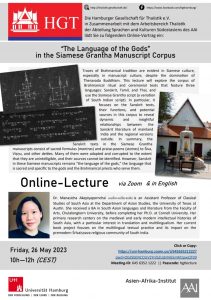
“The Language of the Gods” in the Siamese Grantha Manuscript Corpus on 26 May 2023

Friday, 26 May 2023
10h—12h (CEST) HGT_online_Manasicha


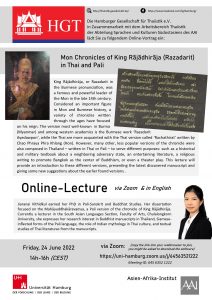
Online Lecture “Mon Chronicles of King Rājādhirāja (Razadarit) in Thai and Pali” on 24.06.2022

Online Lecture “Mon Chronicles of King Rājādhirāja (Razadarit) in Thai and Pali” by Jiaranai Vithidkul

Friday, 24 June 2022. 14h-16h (CEST)

Zoom: https://uni-hamburg.zoom.us/j/64563521222


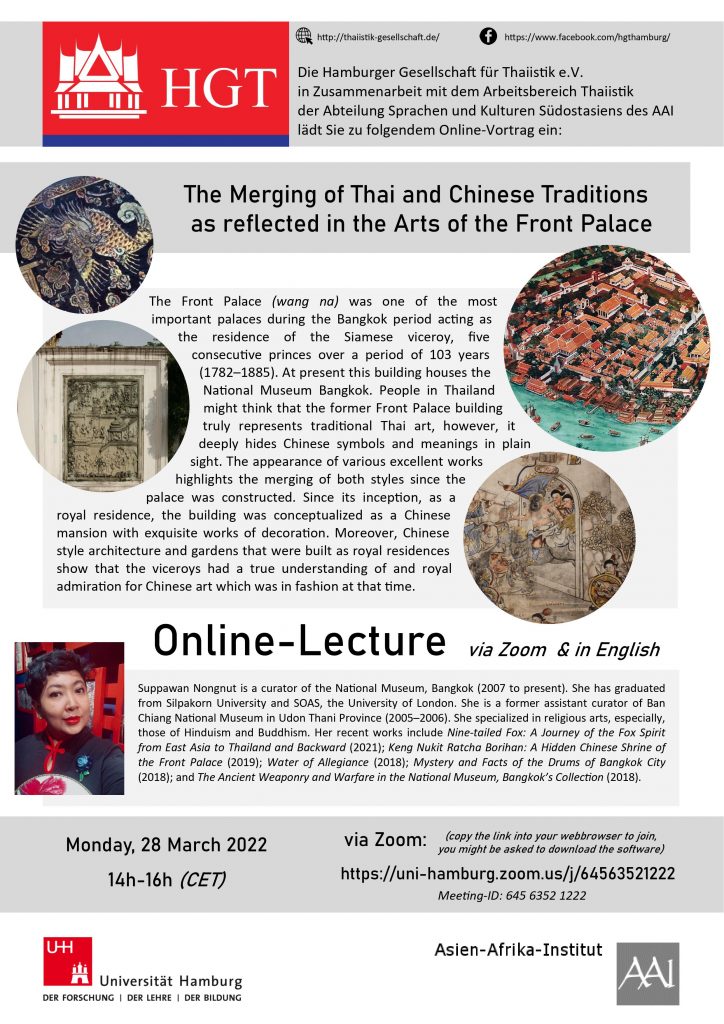
Online Lecture “The Merging of Thai & Chinese Traditions as reflected in Arts of Front Palace” on 28.03.2022

Online Lecture “The Merging of Thai and Chinese Traditions as reflected in the Arts of the Front Palace” by Suppawan Nongnut

Monday, 28 March 2022. 14 – 16 hrs. 

Zoom: https://uni-hamburg.zoom.us/j/64563521222


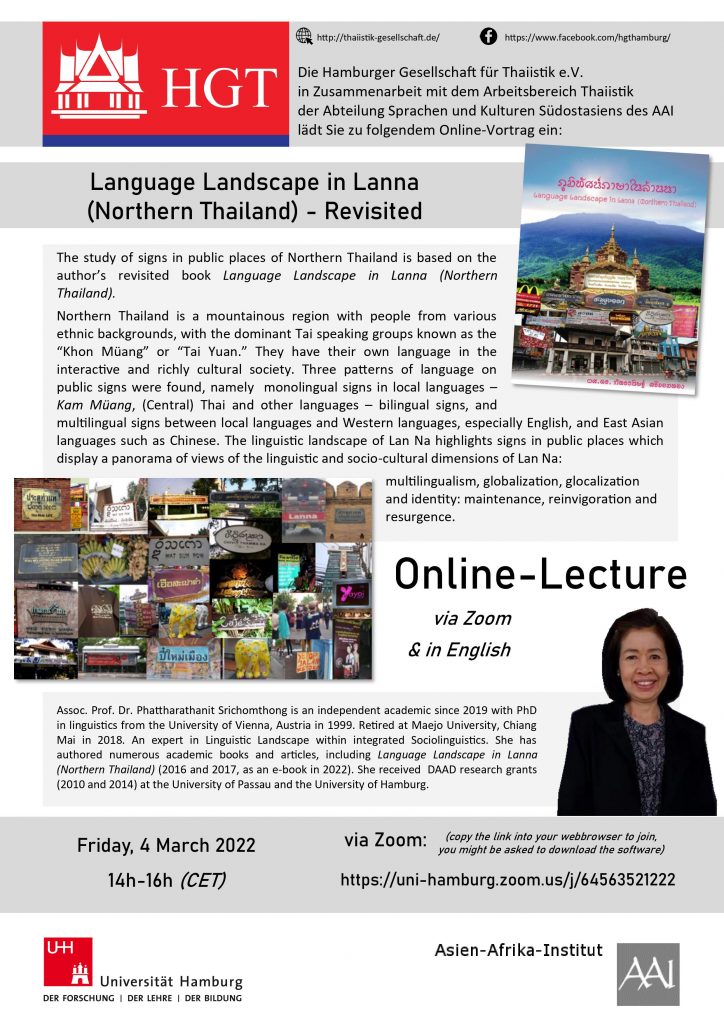
Online Lecture “Language Landscape in Lanna – Revisited” on 4 March 2022

Online Lecture “Language Landscape in Lanna (Northern Thailand) – Revisited” by Assoc. Prof. Dr. Phattharathanit Srichomthong.

Friday, 4 March 2022, 14 – 16 hrs. 

Zoom: https://uni-hamburg.zoom.us/j/64563521222


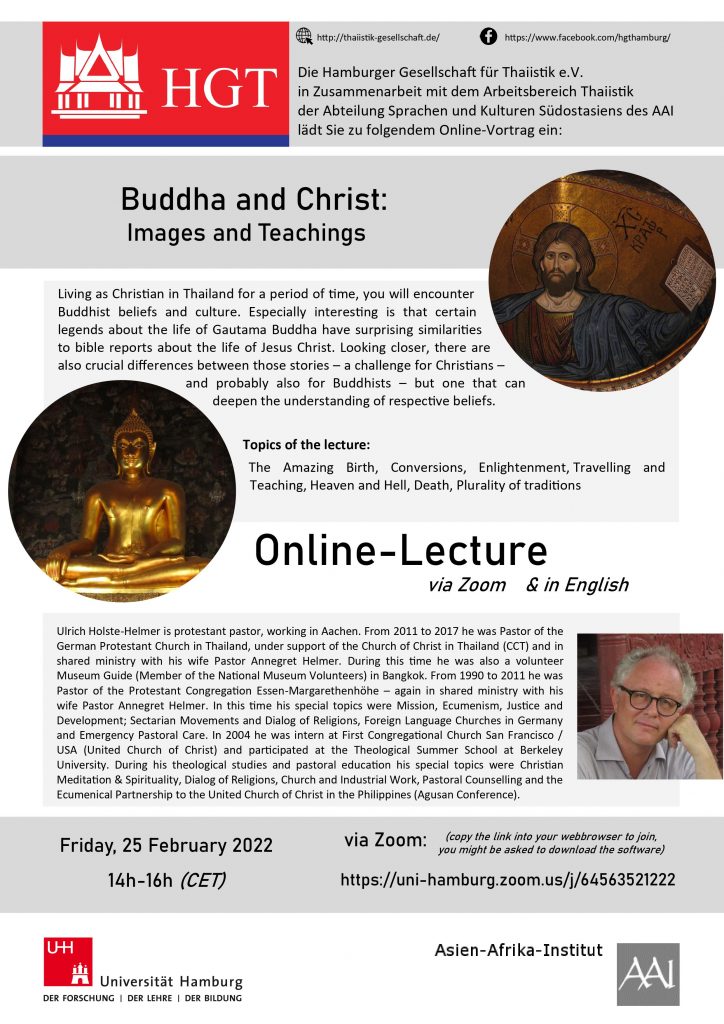
Online Lecture “Buddha and Christ – Images & Teachings” on 25 February 2022

Friday, 25 February 2022, 14 – 16 hrs. 

Zoom: https://uni-hamburg.zoom.us/j/64563521222


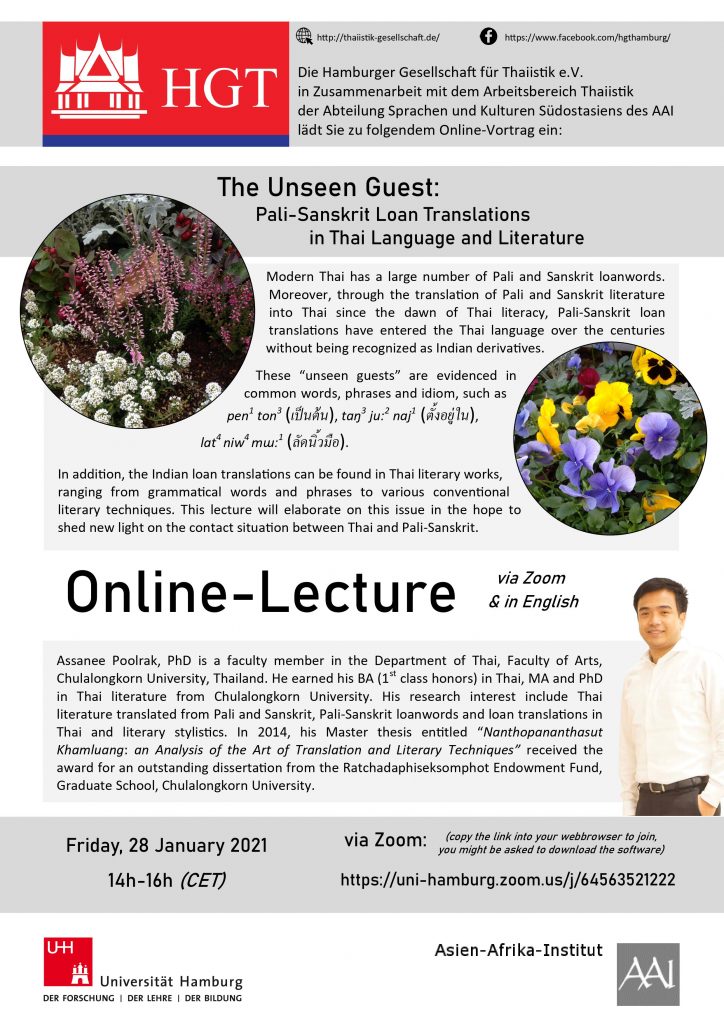
Online Lecture “The Unseen Guest” on 28.01.2022

Modern Thai has a large number of Pali and Sanskrit loanwords. This lecture will elaborate on this issue in the hope to shed new light on the contact situation between Thai and Pali-Sanskrit.

Friday, 28 January 2022, 14 – 16 hrs. 

Zoom: https://uni-hamburg.zoom.us/j/64563521222


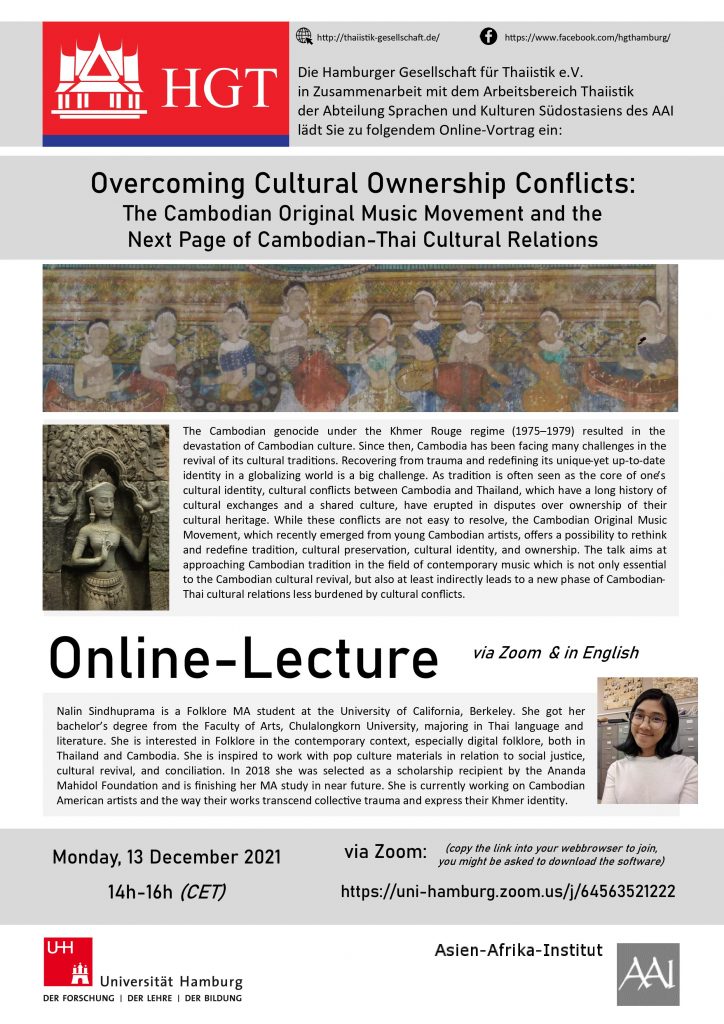
Online Lecture “Overcoming Cultural Ownership Conflicts” on 13.12.2021

The Cambodian genocide under the Khmer Rouge regime (1975–1979) resulted in the devastation of Cambodian culture. Since then, Cambodia has been facing many challenges in the revival of its cultural traditions. The talk aims at approaching Cambodian tradition in the field of contemporary music which is not only essential to the Cambodian cultural revival, but also at least indirectly leads to a new phase of Cambodian- Thai cultural relations less burdened by cultural conflicts.

Monday, 13 December 2021,  14 – 16 hrs.

Zoom: https://uni-hamburg.zoom.us/j/64563521222 


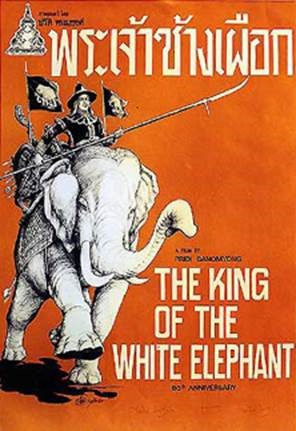
Thai movie “The King of the White Elephant” on 24.11.2021

Date: Wednesday, 24 November 2021, 19:00 hrs.

Venue: Saal 2, EG, Humboldt Forum, Schloßplatz 10178 Berlin

More information and tickets: https://www.humboldtforum.org/de/programm/termin/film-video/the-king-of-the-white-elephant-32601/ 


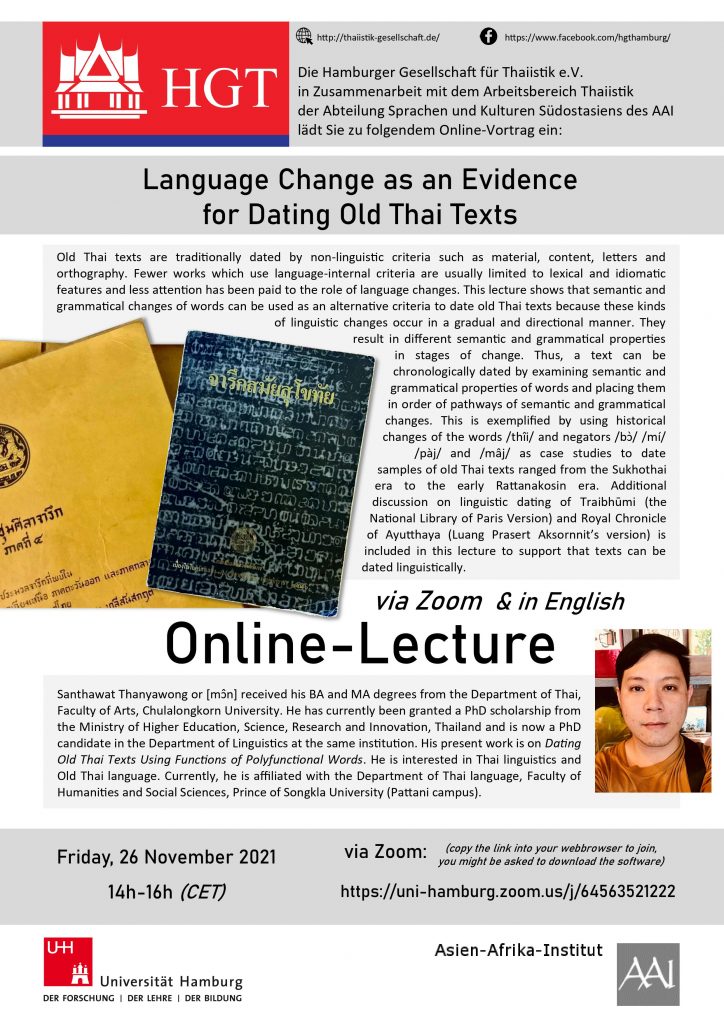
Online Lecture “Language Change as an Evidence for Dating Old Thai Texts” on 26.11.2021

Old Thai texts are traditionally dated by non-linguistic criteria such as material, content, letters and orthography. Fewer works which use language-internal criteria are usually limited to lexical and idiomatic features and less attention has been paid to the role of language changes. This lecture shows that semantic and grammatical changes of words can be used as an alternative criteria to date old Thai texts because these kinds of linguistic changes occur in a gradual and directional manner

Friday, 26 November 2021, 14 – 16 hrs. 

Zoom: https://uni-hamburg.zoom.us/j/64563521222


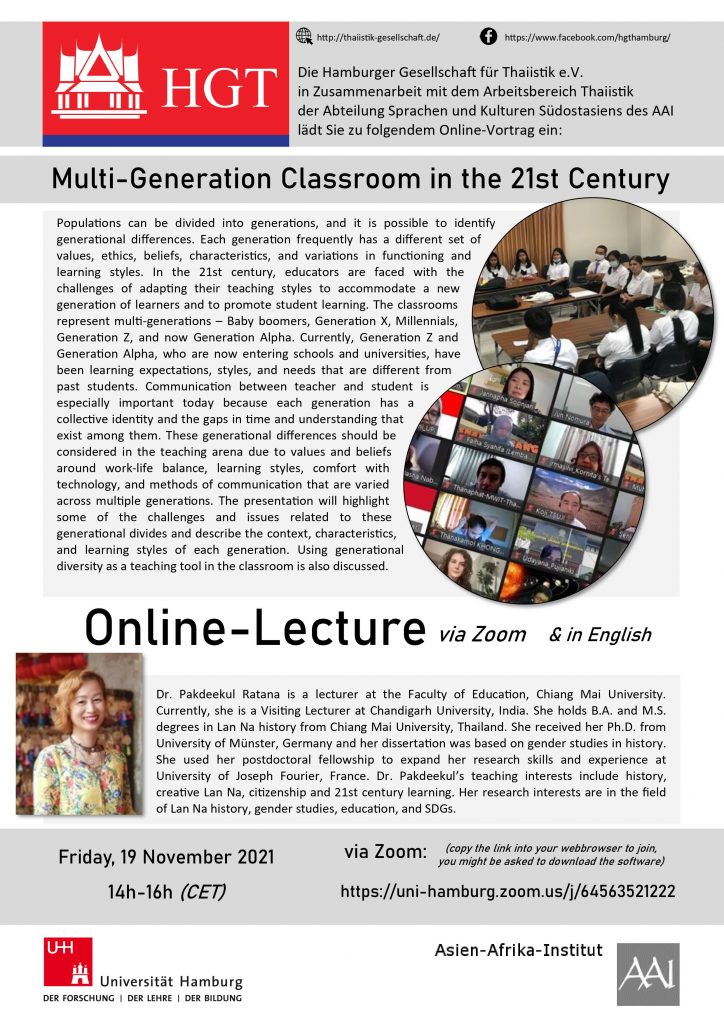
Online Lecture “Multi-Generation Classroom in the 21st Century”

In the 21st century, educators are faced with the challenges of adapting their teaching styles to accommodate a new generation of learners and to promote student learning. The presentation will highlight some of the challenges and issues related to these generational divides and describe the context, characteristics, and learning styles of each generation. Using generational diversity as a teaching tool in the classroom is also discussed.

Friday, 19 November 2021, 14 – 16 hrs. 

Zoom:  https://uni-hamburg.zoom.us/j/64563521222


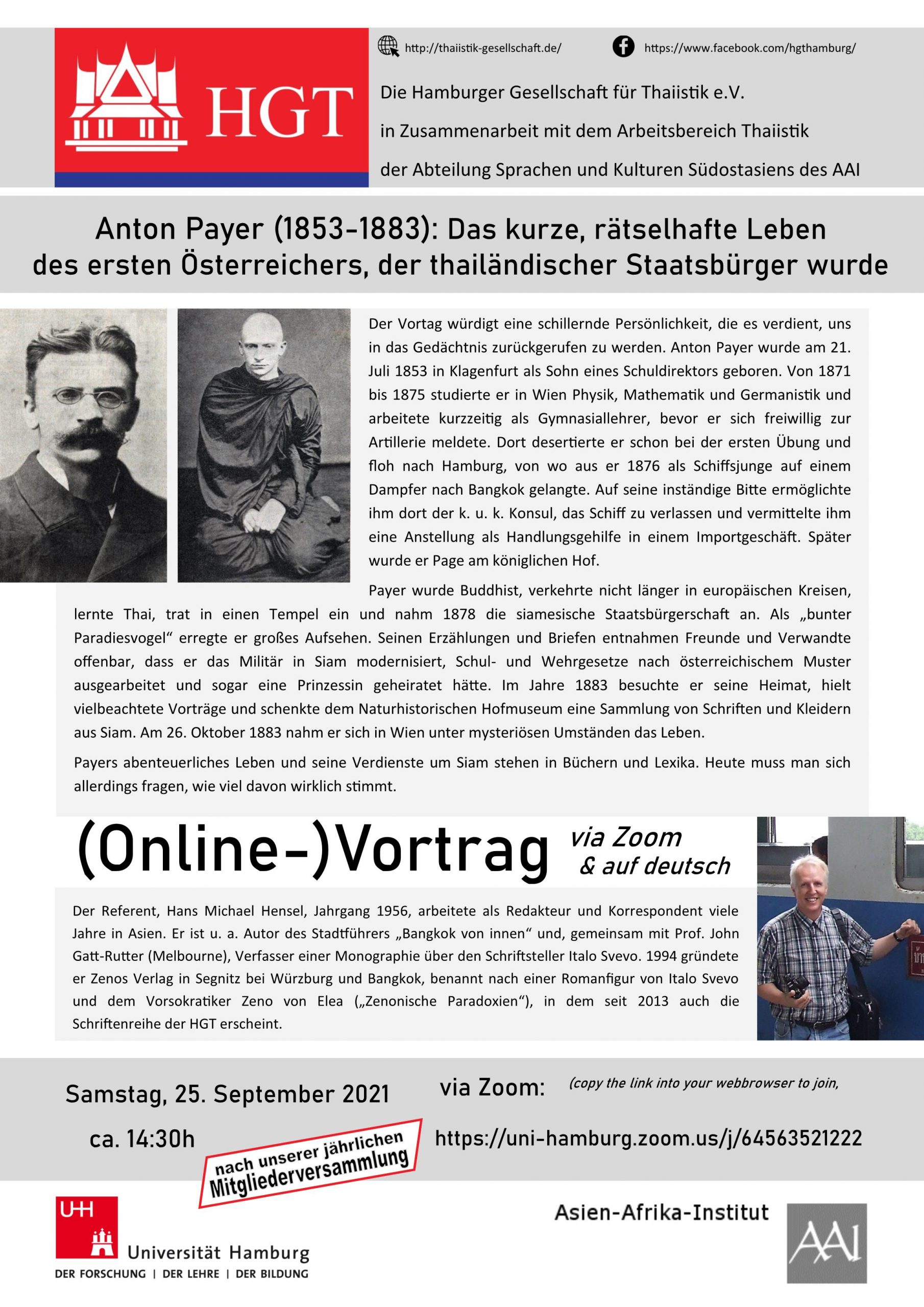
Online Lecture “Anton Payer (1853-1883): Das kurze, rätselhafte Leben des ersten Österreichers, der thailändischer Staatsbürger wurde”

The Hamburger Gesellschaft für Thaiistik invites you to join the online lecture “Anton Payer (1853-1883): Das kurze, rätselhafte Leben des ersten Österreichers, der thailändischer Staatsbürger wurde”

25. September 2021, 14.30 hrs. 


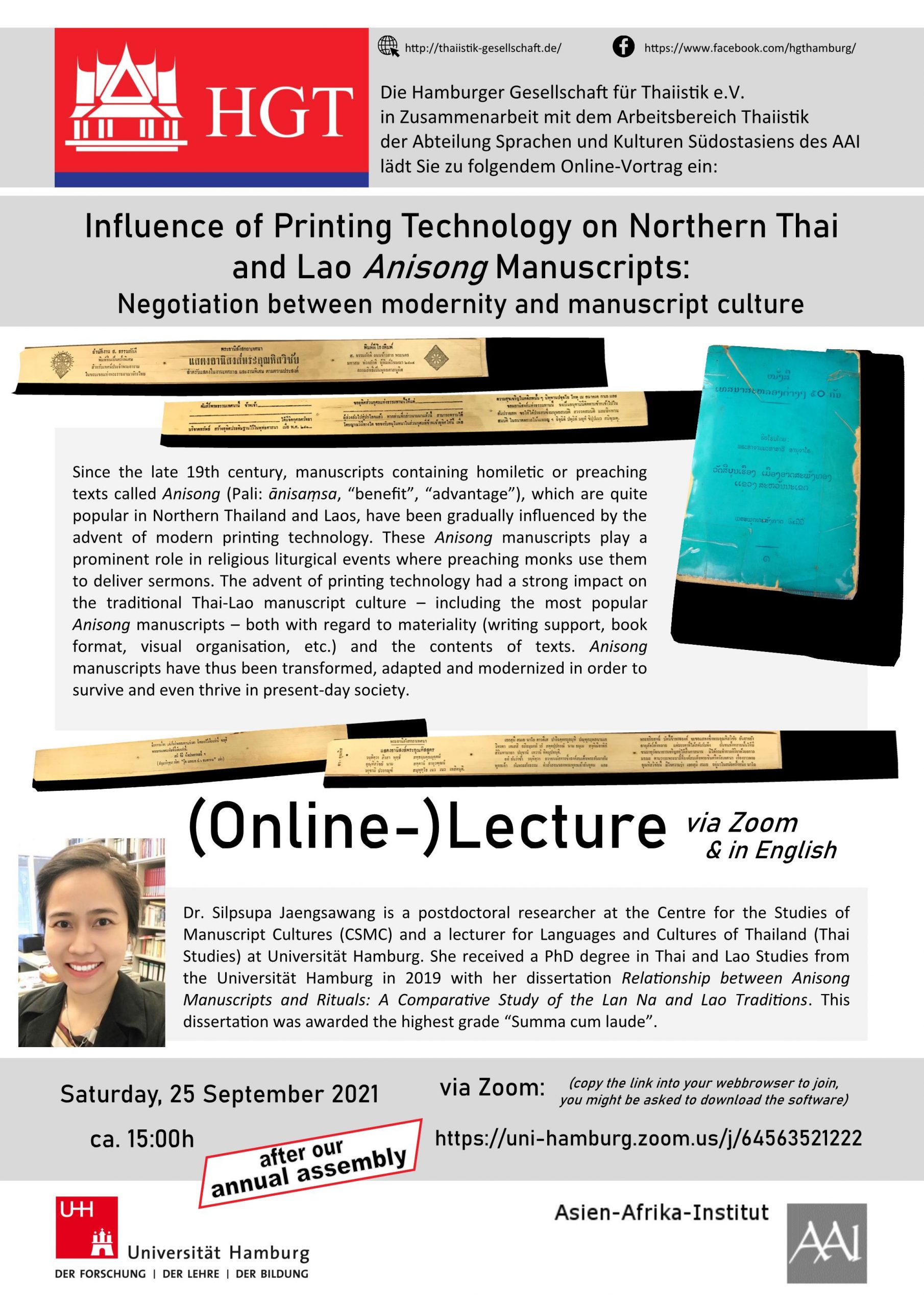
Online Lecture “Influence of Printing Technology on Northern Thai and Lao Anisong Manuscripts”

The Hamburger Gesellschaft für Thaiistik (HGT) invites you to join the online lecture “Influence of Printing Technology on Northern Thai and Lao Anisong Manuscripts: Negotiation between modernity and manuscript culture”

24. September 2021, 15.00 hrs. 


Webinar “Hydrogen Opportunities between Thailand and Germany” by Royal Thai Embassy

The Royal Thai Embassy in Berlin invites you to join our webinar on “Hydrogen Opportunities between Thailand and Germany”

28 September 2021, 10.00 – 12.30 hrs.

For program and more information:

(more…)


Online Lecture “Chao Awat: The Incongruity in Sangha Governance” on 30 August 2021

The chao awat or abbot of a Thai Buddhist monastery plays an important role in Buddhist Thai culture. They act as leaders, teachers, masters of monastic monks and novices, villagers, and laypeople nearby.

This lecture will discuss how the head of a Thai Buddhist monastery is problematic in the balance of the Sangha governance designed by the Buddha, and possibilities for solutions will be discussed.


Date and time: 30 August 2021, 14h – 16h (CEST)

Format: Online Lecture via Zoom  (https://uni-hamburg.zoom.us/j/64563521222)

Language: English


More information and flyer: please click here